Which Senator Was Behind the Secret Hold on the Coburn-Obama Spending Database Bill?
Two senators turned out to be behind it. In late August 2006 a spokesman for Sen. Ted Stevens (R-AK) confirmed that Stevens had placed the hold, and Sen. Robert Byrd (D-WV) later acknowledged a hold of his own and lifted it. After the holds were lifted, the Senate passed the Federal Funding Accountability and Transparency Act by unanimous consent on September 7, 2006, and the database it required went live as USAspending.gov on December 13, 2007. Congress banned earmarks in 2011 and brought them back in 2021. The House now calls them Community Project Funding and the Senate calls them Congressionally Directed Spending. As of November 2026, the FY2027 earmarks are still unenacted, because the government is running on a stopgap through December 11, 2026.
The original post: an anonymous hold on Coburn-Obama
A news report at the time summed up the situation this way: “An unknown number of senators have blocked legislation to create a public, searchable Web site of all federal grants and contracts. Senate rules permit any senator to anonymously block consideration of a bill on the floor, effectively killing the measure.”
The bill was S. 2590. Sen. Tom Coburn (R-OK) introduced it in April 2006, and its cosponsors included Sen. Barack Obama (D-IL), Sen. Tom Carper (D-DE) and Sen. John McCain (R-AZ). It required public disclosure of every entity receiving federal awards, starting in fiscal year 2007.
The original post argued that the bill was not necessarily dead. The senator or senators behind the hold could withdraw it, or the Senate could change its rules so that holders had to be named. The post also noted that the bill had backing from more than 100 organizations across the political spectrum, according to its supporters.
The suspects the post named
The author pointed to two Republican senators as likely candidates.
- Sen. Ted Stevens, R-AK. In October 2005, during floor debate on a Coburn amendment that would have moved money from Alaska’s Gravina Island bridge, widely called the “Bridge to Nowhere,” to rebuilding work after Hurricane Katrina, Stevens told the Senate he would resign if the amendment passed. The amendment was defeated.
- Sen. Trent Lott, R-MS, a former Senate Majority Leader. The original post quoted Lott as saying: “I’ll just say this about the so-called Porkbusters. I’m getting damn tired of hearing from them. They have been nothing but trouble ever since Katrina.”
Stevens turned out to be one of the holders. Lott was never shown to have placed a hold on the bill.
The call-in campaign
The post urged bloggers to phone every Senate office, ask whether that senator had placed the hold, and post a running tally of the answers. The author expected most offices to answer “no,” “no comment” or “we don’t know.” The post also suggested that whoever was exposed might pay a political price for blocking a measure meant to show the public how federal money is spent.
That is roughly what happened. PorkBusters, TPMmuckraker, the Sunlight Foundation and other bloggers and groups on both the right and the left asked readers to call their senators. Offices put their answers on the record one by one, and the list of senators who had not denied a hold kept getting shorter.
What happened next: the holds came out and the bill became law
The hold was exposed within about two weeks, and the bill became law within six weeks. Coburn said on August 17, 2006, that Stevens was the senator blocking the bill. Stevens’s office confirmed the hold on August 30. His spokesman, Aaron Saunders, said the senator was concerned about the bill’s cost and wanted a cost-benefit analysis.
Byrd then acknowledged that he too had placed a hold, and he lifted it. Contemporary accounts say Stevens also briefly lifted his hold and then put it back before the bill finally cleared the Senate.
| Date | Event |
|---|---|
| April 2006 | Coburn introduces S. 2590 with Obama, Carper and McCain |
| August 2006 | Bloggers and advocacy groups run call-in campaigns to identify the holder |
| August 17, 2006 | Coburn names Stevens as the senator blocking the bill |
| August 30, 2006 | Stevens’s spokesman confirms the hold |
| Late August to early September 2006 | Byrd acknowledges a separate hold and lifts it |
| September 7, 2006 | Senate passes the bill by unanimous consent |
| September 13, 2006 | House passes the bill |
| September 26, 2006 | President George W. Bush signs it into law; Obama attends with bloggers who worked on the campaign |
| December 13, 2007 | The Office of Management and Budget (OMB) launches USAspending.gov, a month ahead of the legal deadline |
The spending database today
The 2006 law created USAspending.gov, which is still the federal government’s official public source for award and spending data. OMB launched it on December 13, 2007.
Its early data had gaps. In a March 2010 review (GAO-10-365), the Government Accountability Office found that OMB had fully met six of the nine requirements it checked and partly met one. GAO also found many mismatches between the website and agency records in a random sample of 100 awards. Subaward data, required from January 2009, was missing at the time.
Congress expanded the system with the Digital Accountability and Transparency Act of 2014, known as the DATA Act. It set common data standards for all agencies and tied the site to Treasury financial data. Today the site is where you can look up a federal contract, grant or loan by recipient, place or agency.
Secret holds after 2006
Senate holds still exist, but the rules for anonymous holds changed twice after this fight. The Honest Leadership and Open Government Act of 2007 included a disclosure requirement (Section 512) that gave senators six session days to make their holds public.
On January 27, 2011, the Senate adopted S.Res. 28 by a vote of 92 to 4. Sen. Ron Wyden (D-OR), Sen. Chuck Grassley (R-IA) and Sen. Claire McCaskill (D-MO) led the effort. Under this standing order, a senator who objects to a bill or nomination has to disclose the objection in the Congressional Record within two session days. Notices go into a “Notice of Intent to Object” section of the Senate calendar.
Supporters called it the end of secret holds. Some later analyses disagreed, including the Congressional Research Service report “Holds” in the Senate (R43563) and academic work on Senate transparency. They found that senators could get around the rule, for example by having another senator object on their behalf or by never formally lodging a hold. Grassley and Wyden sent their colleagues a reminder memo about the disclosure rules in 2019.
Earmarks after PorkBusters
The earmarks PorkBusters campaigned against were banned for about a decade and then came back with new rules. From 2006 to 2010, PorkBusters was a blogger-run campaign against congressional earmarks. In 2011, House Republicans and then the Senate adopted a moratorium on earmarks. Starting in 2021, with the FY2022 appropriations bills, Congress restored them as Community Project Funding (House) and Congressionally Directed Spending (Senate).
How earmarks work in November 2026
The current system is based on disclosure:
- Members file project requests with the House or Senate Appropriations subcommittees each spring. The House capped requests at 20 per member for FY2027, up from 15 for FY2026, according to the National Taxpayers Union.
- Members post their requests online and certify that they and their immediate families have no financial interest in the projects. In the House, for-profit companies cannot receive these grants.
- The committees publish the approved projects in tables that accompany each bill. Total earmark spending is limited to a small share of discretionary spending, set at 1 percent when the practice returned.
- Earmarks take effect only when they are included in enacted appropriations legislation, which usually means full-year bills but can include continuing resolutions. Stopgap continuing resolutions generally do not carry new earmarks, and the FY2025 full-year continuing resolution included none.
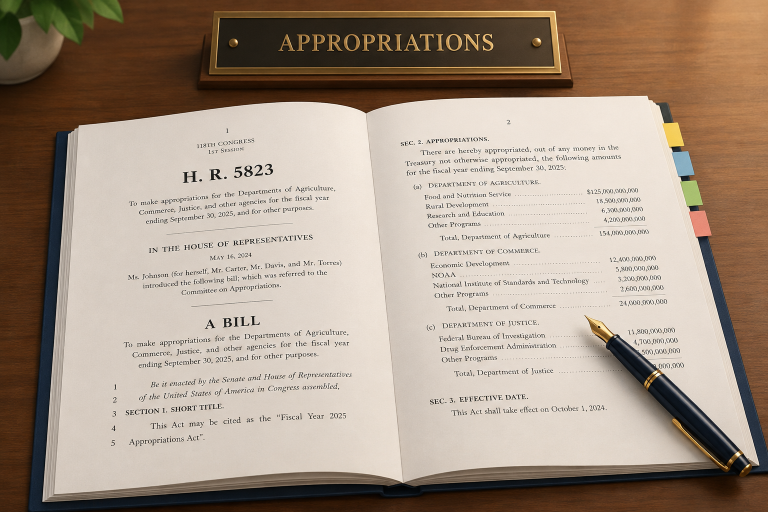
For FY2026, the enacted Agriculture appropriations law alone carried 746 earmarks worth $931 million across nine USDA accounts, according to CRS. For FY2027, the House Appropriations Committee advanced its bills over the spring and summer of 2026. On September 2, 2026, President Trump signed H.R. 6500, the Continuing Appropriations and Extensions Act, 2027 (P.L. 119-103). The Senate passed it 90 to 6 and the House 370 to 48. It funds the government through December 11, 2026. FY2027 earmarks will depend on whether Congress passes full-year bills before or after that deadline.
Critics and supporters still disagree about earmarks. Groups such as Taxpayers for Common Sense and the National Taxpayers Union track every request and argue that more scrutiny is still needed. Appropriators from both parties argue that members know their districts’ needs better than agency staff do, and that disclosure has fixed the worst problems of the pre-2011 era.
This post first ran as a PorkBusters update in the Senate, Politics and Corruption categories. The full original appeared at Tapscott’s Copy Desk, the blog of journalist Mark Tapscott.
FAQ
Who placed the secret hold on the Coburn-Obama bill?
Two senators did. Sen. Ted Stevens (R-AK) confirmed his hold through a spokesman on August 30, 2006, and said he was concerned about the bill’s cost. Sen. Robert Byrd (D-WV) also acknowledged a hold and then lifted it.
What did the Coburn-Obama bill do?
The Federal Funding Accountability and Transparency Act of 2006 required a free, public, searchable website of federal awards, showing who receives federal contracts, grants and loans. President George W. Bush signed it on September 26, 2006, and the law required OMB to establish the website, which launched as USAspending.gov on December 13, 2007.
Can senators still place secret holds?
Not officially. Since S.Res. 28 passed 92 to 4 in January 2011, a senator who objects to a bill or nomination must disclose it in the Congressional Record within two session days. Researchers, including CRS, have found that informal and proxy holds can still keep the original senator’s identity hidden.
Are earmarks banned in Congress?
No. Congress banned earmarks from 2011 and brought them back in 2021 for FY2022, as Community Project Funding in the House and Congressionally Directed Spending in the Senate. Requests are now posted publicly, and members must certify they have no financial interest in the projects.
How can I see where federal money goes?
USAspending.gov lists federal contracts, grants, loans and other awards by recipient, agency and location. Earmarked projects are listed in the House and Senate Appropriations Committee tables for each bill and on members’ own websites.
What was PorkBusters?
PorkBusters was a campaign run by bloggers from 2006 to 2010 against congressional earmarks. It started after Hurricane Katrina, when bloggers asked Congress to offset recovery spending by cutting earmarks. The campaign also pressed for the Coburn-Obama transparency bill.
Sources
- Federal Funding Accountability and Transparency Act of 2006 (Ballotpedia)
- Senator from Bridge to Nowhere outed for secret hold (Mother Jones)
- Who Has Put the Secret Hold on Transparency Legislation? (Sunlight Foundation)
- GAO-10-365: USAspending.gov review (Government Accountability Office)
- “Holds” in the Senate, R43563 (Congressional Research Service)
- S.Res. 28 text, 112th Congress (Congress.gov)
- Overview of Continuing Appropriations for FY2027, R49353 (Congress.gov, CRS)
- Agriculture and Related Agencies: FY2026 Appropriations, R48564 (Congress.gov, CRS)
- Agriculture and Related Agencies: FY2027 Appropriations, R49343 (Congress.gov, CRS)
About this article
- Fact-checked before publication.
- Published · Updated