
The Earmark Reform Index: How Members of Congress Scored
After the Earmark Reform Index came out in 2007, both parties put a moratorium on earmarks starting in 2011, and Congress went without them for a decade. They returned in 2021 under new names: Community Project Funding in the House and Congressionally Directed Spending in the Senate. As of November 2026, House earmarks are capped at 0.5 percent of discretionary spending and total earmarks at 1 percent, and every request has to be posted publicly with the member’s name on it. The government is running on a stopgap through December 11, 2026, so none of the fiscal year 2027 earmarks are law yet.
The Earmark Reform Index
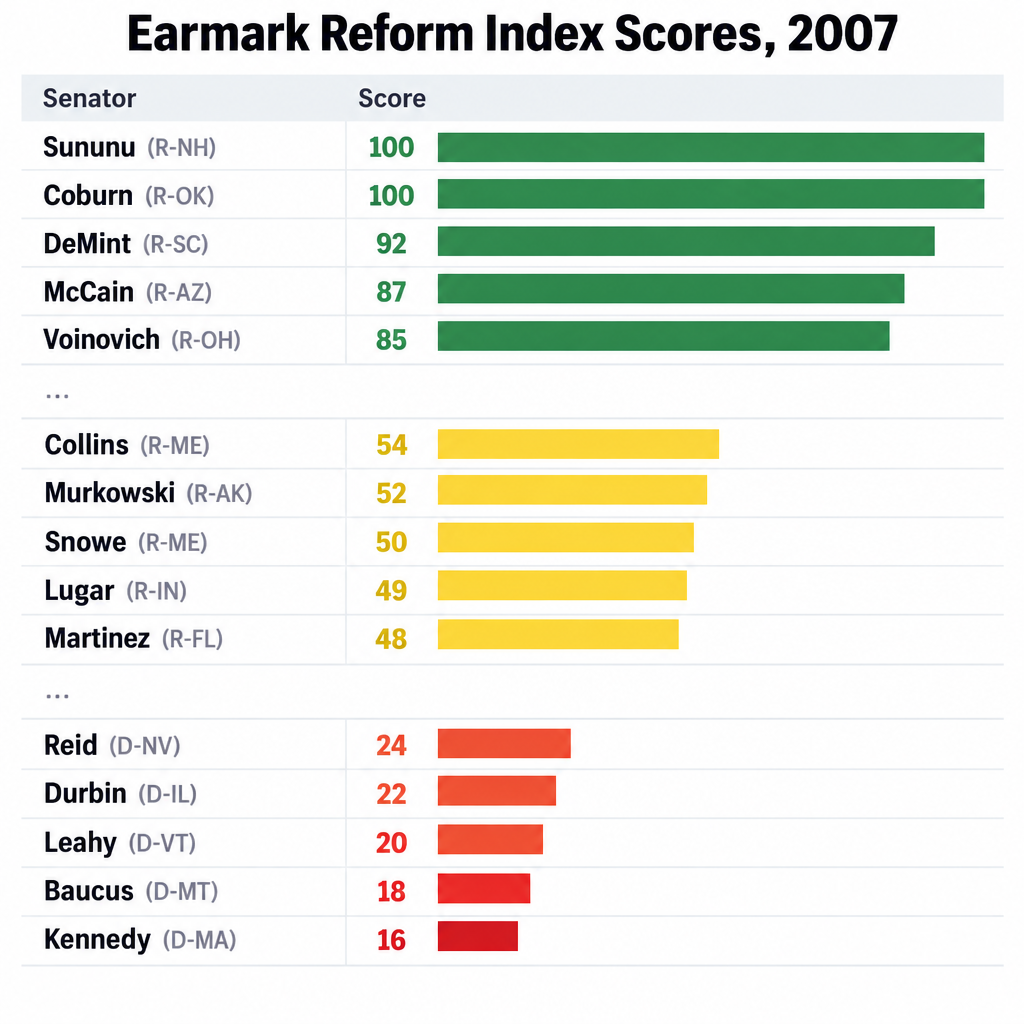
The Earmark Reform Index was a scorecard published in July 2007 by the Examiner newspapers and Porkbusters.org. PorkBusters was a campaign against congressional earmarks launched in September 2005 by bloggers N.Z. Bear and Glenn Reynolds in response to Hurricane Katrina spending, and it ran until 2010. The index rated every senator who served from 2005 to 2007 on how they voted on earmark reform.
a joint project of The Examiner Newspapers and Porkbusters.org
Did your senator vote for earmark reform?
The index was built to test whether senators’ votes matched what they said about wasteful spending. Its creators, the Examiner and PorkBusters, said it showed which senators actually backed reform with their votes and which only talked about it. These were the two organizations’ own judgments, not neutral findings.
How the index was scored
The scoring was simple. It used 12 Senate roll-call votes that the Examiner and PorkBusters considered real chances to reform the earmark process. Before choosing the votes, the organizers said they consulted Senate insiders to make sure each one could have made a real difference.
- The votes: 12 earmark-related roll calls. Three were from 2005, two from 2006 and seven from 2007.
- The points: each pro-reform vote earned about 8.3 points, so a senator who voted for reform all 12 times scored close to 100.
- The reading: higher scores meant a stronger record on earmark reform as the organizers defined it.
What the results showed
Most senators scored low. The Senate average was 30.6. Of the 100 senators, 72 scored below 50. The Examiner said this showed resistance to reform in both parties. The index covered only the Senate. The Examiner said a House version would follow.
Scorecards like this one can contain mistakes, and this one did. The Show-Me Institute pointed out that a later PorkBusters report gave Sen. Claire McCaskill (D-Mo.) a score of 16.6, the third-worst in the Senate, and that the figure was wrong. Any single score from the index should be checked against the roll-call record on Congress.gov.
Background: the earmark votes of 2005 to 2007
These years were the peak of the earmark debate. In October 2005, the Senate voted 82-15 against an amendment from Sen. Tom Coburn (R-Okla.) that would have taken money from Alaska’s “Bridge to Nowhere” and used it for Hurricane Katrina recovery. In 2007, the Honest Leadership and Open Government Act was signed into law on September 14. It required the Senate to disclose earmarks and their sponsors. Disclosure rules have stayed in place in both chambers ever since, including during the ban.
The campaign’s call to action, as history
The index came with a request for readers. PorkBusters and the Examiner asked people to look up their two senators’ scores and contact them. Readers with low-scoring senators were urged to press for better votes. Readers with high-scoring senators were urged to thank them. Calls like these were central to how the campaign worked from 2005 until it wound down in 2010.
|
View All Votes
Ratings By State PowerMaps. Chart. Chart. Chart. |
What happened to earmarks after the index
Earmarks went through three stages after 2007: disclosure, a ban and a return with new limits.
The 2011 to 2021 moratorium
The ban came from party rules, not from law. In November 2010, House and Senate Republicans voted for voluntary bans on earmark requests. In his January 2011 State of the Union address, President Barack Obama said he would veto bills that contained earmarks. On February 1, 2011, Senate Appropriations Chairman Daniel Inouye (D-Hawaii) announced a moratorium covering the fiscal 2011 and 2012 bills. He said, “it makes no sense to accept earmark requests that have no chance of being enacted into law.” According to the Congressional Research Service, the moratorium was never written into House or Senate rules and could not be enforced through a point of order.
The 2021 return
In 2021, the House Appropriations Committee brought back earmarks as Community Project Funding, and the Senate adopted Congressionally Directed Spending. The new system added safeguards that did not exist before 2011:
- A cap on the total amount, originally 1 percent of discretionary spending.
- A limit on how many requests each member could make. The first limit was 10.
- A signed statement from each member that they and their spouse have no financial interest in the project.
- Public posting of every request online.
- No House earmarks for for-profit recipients.
- A Government Accountability Office audit of a sample of funded projects.
How earmarks work as of November 2026
The House now uses a smaller cap than in 2021. For fiscal 2026 and 2027, House Appropriations Chairman Tom Cole (R-Okla.) kept House earmarks at 0.5 percent of discretionary spending. The total for both chambers is limited to 1 percent. For fiscal 2027, each House member could make up to 20 requests, up from 15. The request portal opened February 25, 2026, and members had to post their requests publicly by April 17. In the Senate, Appropriations Chair Susan Collins (R-Maine) and Vice Chair Patty Murray (D-Wash.) issued the fiscal 2027 guidance for requests.
The fiscal 2025 full-year stopgap contained no earmarks. They came back in the fiscal 2026 laws. According to CRS, the fiscal 2026 Transportation-HUD law alone carried $2.4 billion in earmarks. The Council on Criminal Justice counted about $938 million in earmarks in the Justice Department’s budget.
Fiscal 2027 is not settled. President Donald Trump signed H.R. 6500, a stopgap that funds agencies through December 11, 2026, on September 2, 2026. It passed the Senate 90-6 and the House 370-48. Stopgaps do not fund new earmarks. Fiscal 2027 projects, such as those in the House-passed Agriculture bill, become law only if Congress passes full-year spending bills.
FAQ
Did the Earmark Reform Index score House members?
No. The 2007 index covered only senators who served from 2005 to 2007. The Examiner said a House version would follow, but the published index rated the Senate alone.
Are earmarks still banned?
No. The moratorium ran from 2011 until 2021. Earmarks returned for the fiscal 2022 bills as Community Project Funding in the House and Congressionally Directed Spending in the Senate. They are part of the fiscal 2027 process now under way.
How much of the budget goes to earmarks?
Under current committee rules, earmarks from both chambers combined can make up no more than 1 percent of discretionary spending, and the House share is capped at 0.5 percent. Mandatory programs such as Social Security and Medicare are not part of that base, so earmarks are a small share of total federal spending.
How can you see what your members of Congress requested?
Every House member who requests Community Project Funding must post the requests on their official website. The appropriations committees publish tables of funded projects with each bill. Senators who request Congressionally Directed Spending post their requests too.
What happened to PorkBusters?
The PorkBusters campaign was active from 2005 to 2010, during the fight over earmark disclosure and the run-up to the 2011 moratorium. Since 2026, the web address has belonged to new owners with no connection to the campaign. It is now home to a nonpartisan site that explains federal spending.
Sources
- Washington Examiner: Index shows lawmakers still court earmarks
- Show-Me Institute: Corrected Numbers for Sen. McCaskill
- Congressional Research Service: Community Project Funding: House Rules and Committee Protocols (R46722)
- Congressional Research Service: Transportation, Housing and Urban Development Appropriations for FY2026 (R48728)
- Congressional Research Service: Agriculture and Related Agencies: FY2027 Appropriations (R49343)
- Roll Call: Inouye relents to anti-earmark movement, for now
- White House: Congressional Bill H.R. 6500 Signed into Law
- Committee for a Responsible Federal Budget: Appropriations Watch: FY 2027
About this article
- Fact-checked before publication.
- Published · Updated