
Where to Find Earmark and Pork-Barrel Spending Data
Congress stopped earmarking in 2011 and brought the practice back in 2021 under new names. House earmarks are now called Community Project Funding, and Senate earmarks are called Congressionally Directed Spending. Lawmakers must post their requests online, certify that they have no financial interest in them, and send the money only to public bodies and nonprofits. As of November 2026, no fiscal 2027 earmarks have become law. The government is running on a stopgap that lasts through December 11, 2026, and the House and Senate request lists are public while lawmakers negotiate the final bills.
Pork Resources
The original resource list (2005 to 2010)
During the PorkBusters campaign, the site sent readers to three resources for tracking pork-barrel spending. The table below shows them as they were listed, with corrected descriptions. The Pig Book entry is a historical record. The two congressional sites still do the same job today.
| Resource | What it offered |
|---|---|
| The 2005 Pig Book | A searchable database of 13,997 pork projects in the fiscal 2005 spending bills, published by Citizens Against Government Waste (CAGW) |
| House.gov | A tool to find your representative and congressional district |
| Senate.gov | A tool to find your two senators |
What the 2005 Pig Book found
CAGW’s 2005 edition counted 13,997 projects in the 13 fiscal 2005 appropriations bills, at a total cost of $27.3 billion. That was 31 percent more projects than the 10,656 it found for fiscal 2004, and 19 percent more money than that year’s $22.9 billion. CAGW called it the most pork in its records up to that point.
The group used seven criteria to label an item “pork.” Two examples are projects that were not in the president’s budget request and projects that had not been specifically authorized. Because CAGW sets its own definition, its totals are higher than the official earmark counts Congress publishes today, and the two should not be read as the same measure.
What PorkBusters was
PorkBusters was an online campaign run by bloggers against congressional earmarks. It began in the fall of 2005, after Hurricane Katrina. Glenn Reynolds of the Instapundit blog promoted the idea, and the blogger known as N.Z. Bear built a site that tracked where members of Congress stood on spending cuts. The campaign asked readers to call their senators and representatives and to send in local examples of pork. That is why its resource list centered on tools for finding your own members.
The campaign backed an amendment from Sen. Tom Coburn (R-Okla.) in October 2005. The amendment would have moved money from Alaska’s Gravina Island bridge, known as the “Bridge to Nowhere,” to rebuild a Katrina-damaged bridge in Louisiana. Sen. Ted Stevens (R-Alaska) opposed it, and the Senate rejected it 82 to 15. The campaign stayed active until about 2010, the year before Congress adopted its earmark moratorium.
How earmarks work as of November 2026

Earmarks never left the rule books. Congress stopped approving them in 2011 by agreement, then started again for fiscal 2022 under stricter disclosure rules. Each chamber now runs its own version, and each has a cap tied to total discretionary spending.
The ban and the return
Both chambers followed an earmark moratorium starting with the 112th Congress (2011 to 2012). According to the Congressional Research Service (CRS), the moratorium was a policy commitment and not a chamber rule, so no point of order enforced it. The disclosure rules written in 2007, which define an earmark as congressionally directed spending, a limited tax benefit or a limited tariff benefit, stayed in force the whole time.
In 2021 the appropriations committees, led then by Rep. Rosa DeLauro (D-Conn.) in the House and Sen. Patrick Leahy (D-Vt.) in the Senate, reopened member requests for the fiscal 2022 bills. House Republicans also voted that year to allow their members to take part. Fiscal 2025 turned out to be a gap year: Congress passed none of its 12 regular spending bills and funded the government with a full-year continuing resolution that carried no earmarks.
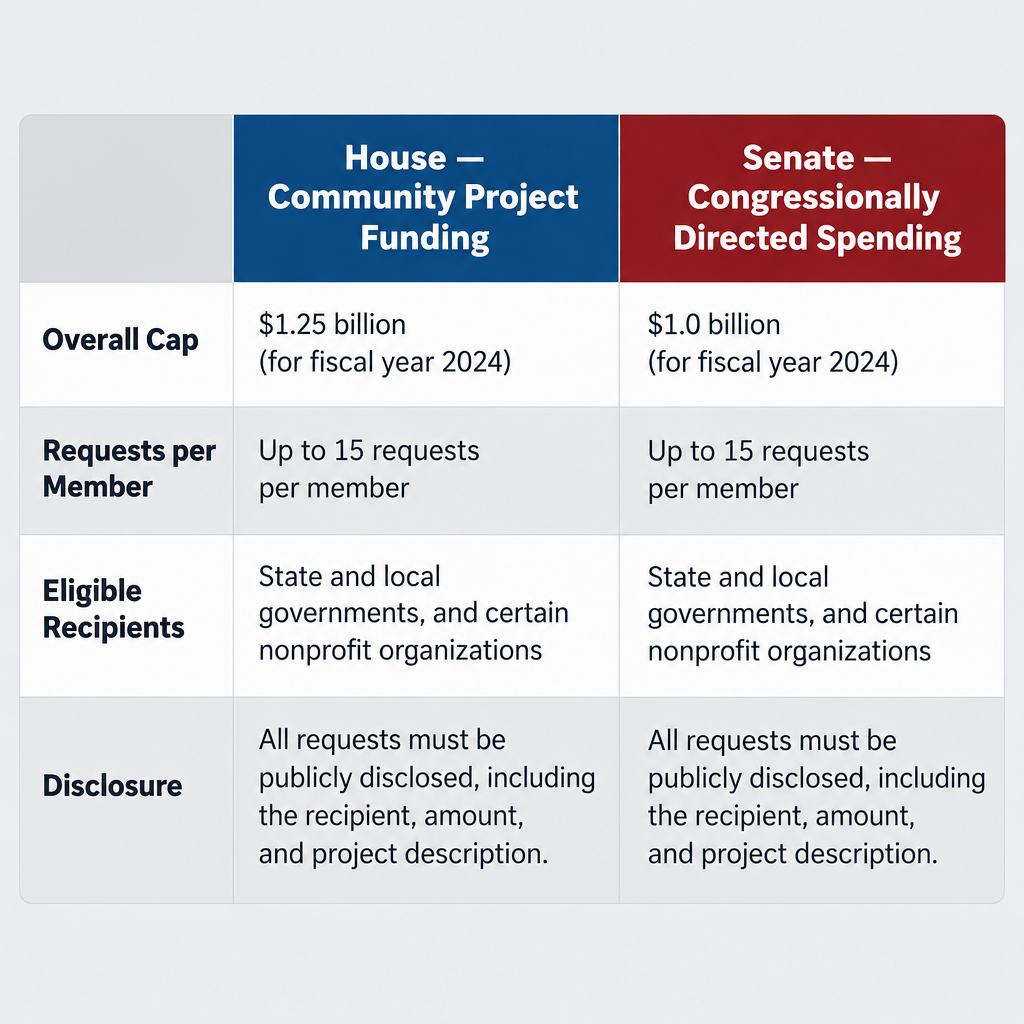
House and Senate rules side by side
| Feature | House: Community Project Funding | Senate: Congressionally Directed Spending |
|---|---|---|
| Overall cap | 0.5% of discretionary spending, per House Appropriations guidance | 1% of discretionary spending |
| Requests per member, FY2027 | Up to 20 (15 in FY2026), under guidance from Chairman Tom Cole (R-Okla.) | No fixed number in committee guidance |
| Eligible recipients | Public entities and nonprofits; no for-profit companies | No for-profit companies; only certain accounts are eligible |
| Disclosure | Each member posts requests on their own website; the committee posts links to all of them | Senators post requests and signed financial certification letters; the committee publishes a consolidated table |
| Committee leaders, FY2027 | Chairman Tom Cole | Chair Susan Collins (R-Maine), Vice Chair Patty Murray (D-Wash.) |
How a request becomes funding
- A member collects proposals from local governments and nonprofits in the district or state.
- The member submits up to the allowed number through the committee portal, posts the list online and files a certification of no financial interest.
- Subcommittees choose which requests to fund and list them in tables in committee reports.
- Projects that survive negotiations appear in the explanatory statement for the final enacted bill.
- The federal agency awards the money as a grant, usually months or years later, and the award shows up in federal spending data.
The last step can take a long time. The Government Accountability Office (GAO) reported in July 2026 (GAO-26-107944) that agencies had obligated about 61 percent of the $39 billion set aside for fiscal 2022 through 2024 projects, measured as of the end of fiscal 2024.
The latest earmark figures
The newest complete year is fiscal 2026. Those earmarks were carried in full-year bills enacted between November 2025 and February 2026. The last package was the Consolidated Appropriations Act, 2026 (H.R. 7148, Public Law 119-75). The House passed it 217 to 214, and President Trump signed it on February 3, 2026.
| Measure | Figure | Source |
|---|---|---|
| FY2026 earmarks, CAGW count | 8,392 items, $23.7 billion | CAGW 2026 Congressional Pig Book |
| Change from FY2024, CAGW count | Up 4.4% from $22.7 billion | CAGW |
| Largest individual total, FY2026 | Sen. Patty Murray (D-Wash.), 96 earmarks, $484.7 million | CAGW |
| FY2024 CPF/CDS projects, official designations | 8,098 projects, about $14.6 billion | GAO-25-107549 |
| FY2022 to FY2024 CPF/CDS funds | About $39 billion, about 61% obligated | GAO-26-107944 |
| FY2027 Senate requests | 13,380 requests, $51.97 billion | NTU Foundation tally of the Senate committee table |
The gap between CAGW’s $23.7 billion and the much smaller official totals comes from definitions. CAGW counts 110 items worth $8.3 billion that no lawmaker’s name was attached to, along with items Congress does not classify as earmarks. Lawmakers who back earmarks say the official CPF and CDS lists are the accurate measure, since they cover every item a member requested and disclosed. CAGW and other critics say the official lists leave out large amounts of directed spending. Both numbers are worth knowing. Just don’t compare one directly with the other.
FY2027 requests are a wish list, not spending. The Senate’s $51.97 billion in requests is far above what its 1 percent cap would allow, so most requests will not be funded.
Where to find earmark data today
Which source to use depends on what you want to know: what was requested, what was enacted or where the money ended up.
- Your own members’ websites. House members and senators must post every request they submit. Search for your representative’s or senators’ “appropriations requests” or “community project funding” page.
- House Appropriations Committee website. It links to every House member’s request page and publishes the subcommittee report tables that list the funded projects.
- Senate Appropriations Committee website. It posts the consolidated CDS request table and senators’ financial certification letters.
- Congress.gov. Look here for bill text, committee reports and the explanatory statements that list the final enacted earmarks. CRS reports on earmarks and the status of appropriations are also posted there.
- USAspending.gov. Once an agency awards an earmark as a grant, you can search the award by recipient name, location or agency.
- GAO. The office publishes yearly reviews of how agencies carry out earmarks, plus an interactive “Tracking the Funds” project explorer.
- Outside trackers. CAGW still publishes its Pig Book every year. The 2026 edition, released in May 2026, was its 33rd. The National Taxpayers Union Foundation keeps searchable tallies of House and Senate requests.
What happens next
The stopgap funding law (Division A of Public Law 119-103) runs through December 11, 2026. Until Congress passes full-year fiscal 2027 bills, no new earmarks can be funded. A full-year continuing resolution would leave fiscal 2027 with no earmarks, as happened in fiscal 2025. If the House and Senate pass final bills instead, the funded projects will appear in the explanatory statements on Congress.gov and in the committees’ tables. Comparing those tables with your members’ posted requests shows which projects made it.
FAQ
Are earmarks still banned in Congress?
No. The moratorium ran from 2011 until 2021, and earmarks returned in the fiscal 2022 spending bills. They have appeared in every regular appropriations cycle since then, except fiscal 2025, when a full-year continuing resolution left them out.
What is the difference between Community Project Funding and Congressionally Directed Spending?
Both are earmarks. Community Project Funding is the House’s name, and Congressionally Directed Spending is the Senate’s. The chambers set separate caps: 0.5 percent of discretionary spending in the House and 1 percent in the Senate. They also have slightly different rules on how many requests members can make and which accounts can carry earmarks.
How much did Congress spend on earmarks in fiscal 2026?
Citizens Against Government Waste counted 8,392 earmarks costing $23.7 billion in fiscal 2026, 4.4 percent more than in fiscal 2024. That count uses CAGW’s own broad definition. The official totals of member-requested projects are lower.
How can I see what my representative or senators asked for?
Every member must post their requests on their official website, along with a certification of no financial interest. The House Appropriations Committee links to all House members’ pages, and the Senate Appropriations Committee publishes a consolidated table of Senate requests.
Is the Pig Book still published?
Yes. CAGW released its 33rd edition, the 2026 Congressional Pig Book, in May 2026. CAGW says it has identified 140,826 earmarks costing $484 billion since the first edition in 1991.
Can I trace where an earmark’s money actually went?
Yes, but it takes time. Agencies often award earmark grants a year or more after a bill is enacted. Once awarded, the grants appear on USAspending.gov, and GAO’s yearly reviews report how much of each year’s earmark money agencies have obligated.
Sources
- Overview of Continuing Appropriations for FY2027 (CRS, Congress.gov)
- Lifting the Earmark Moratorium: Frequently Asked Questions (CRS R45429)
- GAO-26-107944: Community Project Funding/Congressionally Directed Spending
- GAO Tracking the Funds project explorer (GAO-25-107549)
- House Appropriations Committee: Cole releases FY27 Community Project Funding guidance
- Senate Appropriations Committee: FY27 Appropriations Requests and Congressionally Directed Spending
- Senate Appropriations Committee: Reforms and Regulations for CDS in FY2027
- White House: H.R. 7148 signed into law
- CAGW: 2026 Congressional Pig Book
- CAGW: 2005 Pig Book release
About this article
- Fact-checked before publication.
- Published · Updated