Simple Solutions for the Serious: Jeff Miron’s Checklist for Cutting Federal Spending
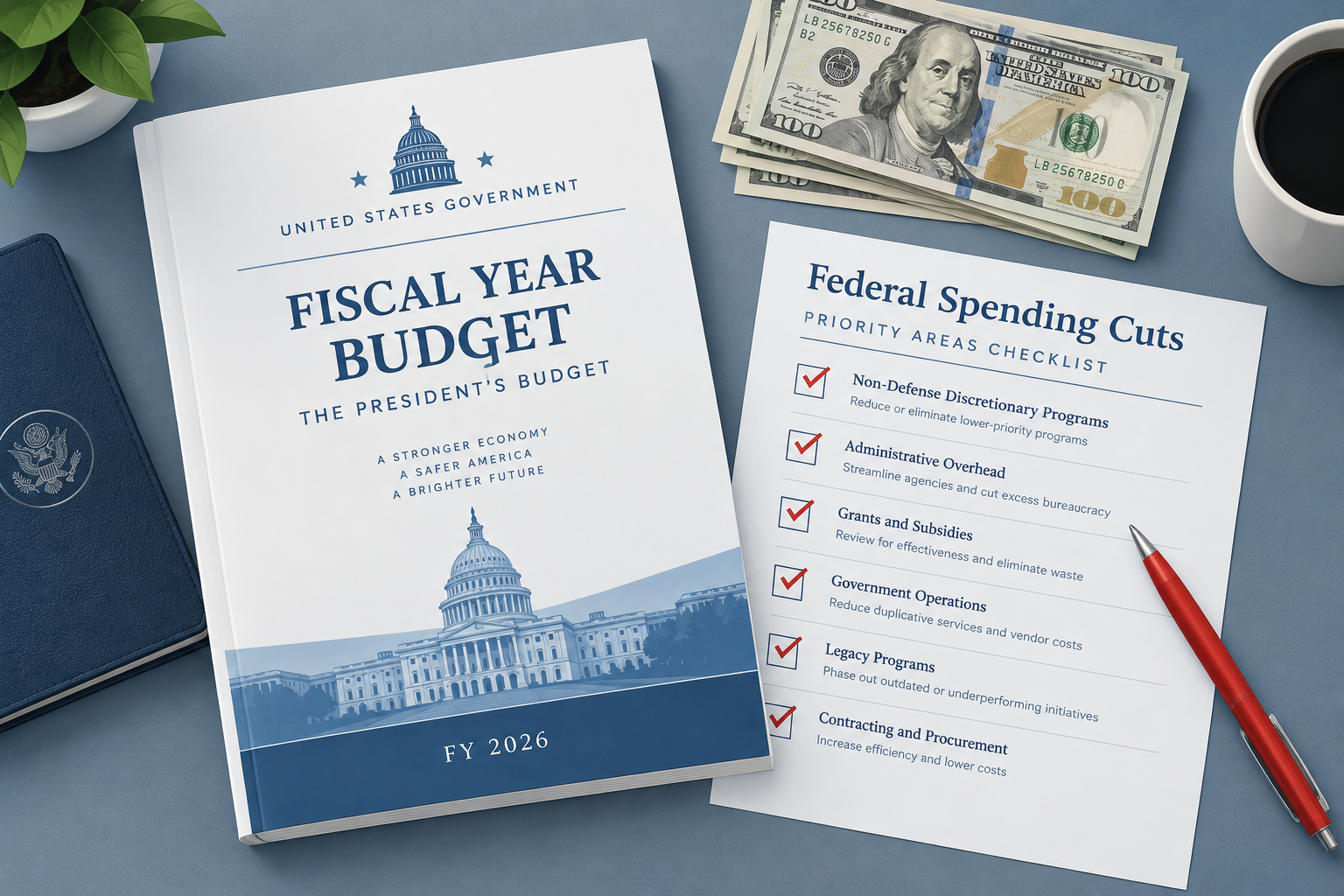
None of the five cuts in Jeff Miron’s 2006 checklist became law. Social Security and Medicare still pay benefits without a means test, farm payments have grown, and the federal deficit reached about $2.0 trillion in fiscal year 2026, according to the Congressional Budget Office. Earmarks were banned in Congress from 2011. They came back in 2021 as Community Project Funding in the House and Congressionally Directed Spending in the Senate, with public disclosure, a ban on for-profit recipients and a cap of 1 percent of discretionary spending. As of November 2026, earmarks for fiscal 2027 are on hold: the government is running on a stopgap law that lasts through December 11, 2026, and earmarks generally take effect only in full-year spending bills.
The original argument (2006)
In 2006, a blog post argued that if anyone in either party was serious about cutting government spending, libertarian Harvard economist Jeff Miron has a simple checklist of what they would do. The post added that neither party did.
Miron argued that the claim “government expenditure cannot be cut” was wrong. He offered a list that he said Democratic economists should also support. Each item came with an estimate of yearly savings in 2006 dollars.
Miron still teaches economics at Harvard, where he is a senior lecturer and director of graduate and undergraduate studies. He is also vice president for research at the Cato Institute, a libertarian think tank.
Miron’s five proposed cuts
Miron’s list added up to about $300 billion a year. At the time, he compared that with the deficit projected for 2006. In January 2006, CBO projected a $337 billion federal budget deficit for fiscal year 2006. Revenue then came in higher than expected, and the Treasury reported a final fiscal 2006 deficit of $248 billion.
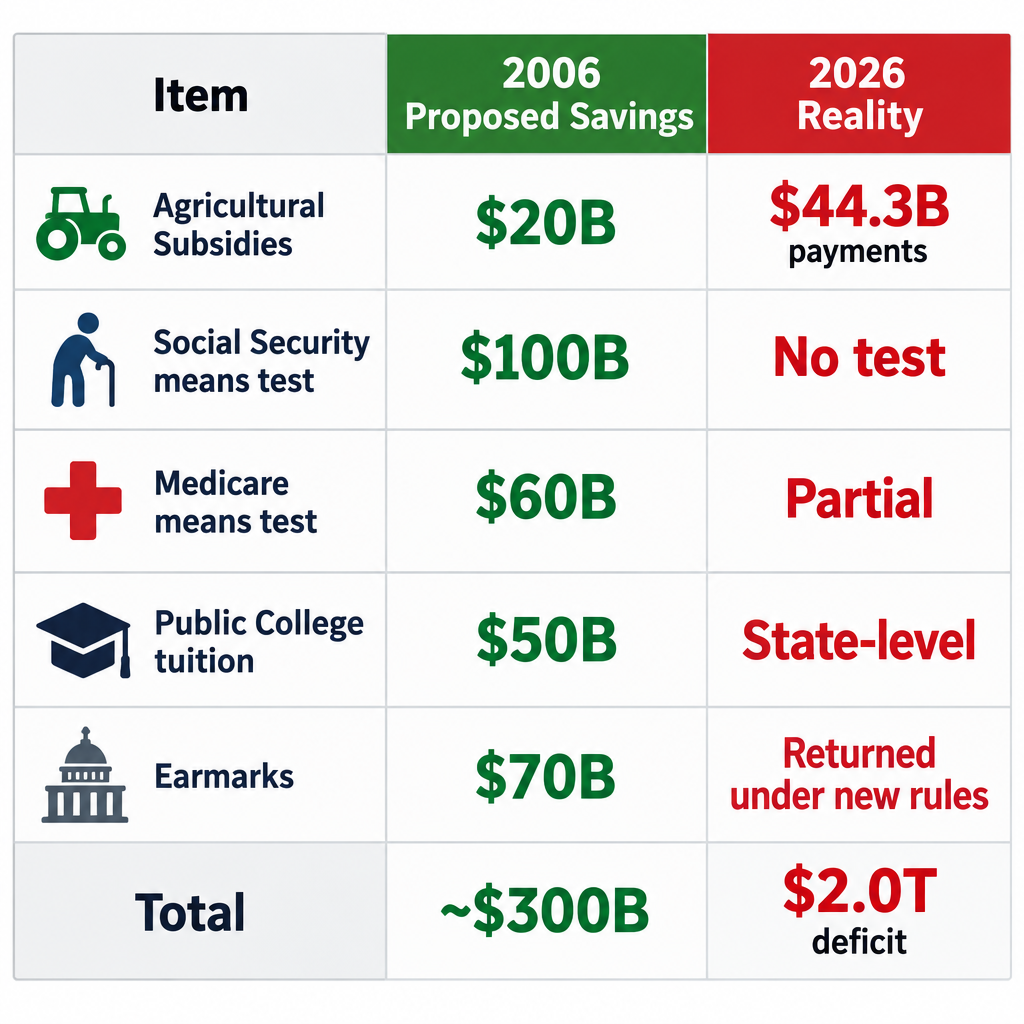
| Proposed cut | Miron’s 2006 estimate (per year) | Where things stood in 2026 |
|---|---|---|
| Agricultural subsidies | $20 billion | USDA’s Economic Research Service forecast $44.3 billion in direct government farm payments for 2026 |
| Means-testing Social Security | $100 billion | No means test. Social Security outlays were more than $1.6 trillion in FY2026 |
| Means-testing Medicare | $60 billion | Partly done: higher-income enrollees pay income-related premiums. Medicare outlays rose 8% in FY2026, according to CBO |
| Means-tested public college tuition | $50 billion | A state-level policy, mostly outside the federal budget |
| Earmarks and other “pork” | $70 billion | Earmarks were banned from 2011 to 2021 and are now back under new rules |
| Total | About $300 billion | FY2026 deficit: about $2.0 trillion |
Agricultural subsidies
Miron called farm subsidies “everyone’s favorite whipping boy.” He argued that they mostly go to well-off farmers and raise food prices for everyone, and he put the possible savings at $20 billion a year.
Farm payments have more than doubled since then. In December 2025, USDA announced a $12 billion aid package, including $11 billion through a new Farmer Bridge Assistance program for row crops. The Economic Research Service expects $23.9 billion of 2026 farm payments to come from ad hoc and disaster aid, mostly that program. Farm groups, including the American Farm Bureau Federation, have said the aid still does not cover the losses farmers have taken in recent years.
Social Security for higher-income retirees
Social Security does not check a retiree’s income before paying benefits. Miron called this “insanity.” His point was that current benefits are paid from taxes on today’s workers, not from money the retirees saved. He proposed cutting Social Security spending by about 20% through a modest means test, which he estimated would save $100 billion a year.
Congress has not adopted a means test. Since 1984, though, part of the benefit has been subject to income tax for retirees above certain income levels, which works a bit like one. The money question is now more urgent. The 2026 Social Security Trustees Report, released June 9, 2026, projects that the retirement trust fund (OASI) will run out of reserves in late 2032. The combined retirement and disability funds would last until 2034, after which incoming taxes would cover about 83% of scheduled benefits.
Medicare for higher-income enrollees
Miron applied the same reasoning to Medicare. He proposed raising premiums, deductibles and co-payments for higher-income enrollees enough to cut spending by 20%, which he estimated would save $60 billion a year.
Some of this already exists. Enrollees with higher incomes pay income-related surcharges on their Part B and Part D premiums. Medicare spending kept climbing anyway: CBO reported that Medicare outlays grew by $77 billion, or 8%, in fiscal 2026 because of higher enrollment and higher payment rates.
Public higher education
Miron argued that state colleges subsidize everyone equally, so wealthy families pay the same low tuition as poor ones. He proposed that states set a high sticker price and give discounts based on need, as private colleges do. He estimated savings of $50 billion.
This item differs from the others. Most of that money is state spending, so a change would affect state budgets far more than the federal deficit.
Earmarks and other “pork”
Miron wrote that single “bridges to nowhere” are small, but there are a lot of them. He cited a Taxpayers for Common Sense estimate of $24 billion in earmarks for 2005. He then added larger items he considered wasteful: manned spaceflight, Amtrak subsidies, transit projects such as Boston’s Big Dig, some Army Corps of Engineers flood control work, subsidized disaster insurance, and state and local pork. All together, he estimated $70 billion a year in savings.
What happened next shaped the next 15 years of the earmark debate:
- 2006 to 2010. PorkBusters, a campaign run by bloggers, pushed for earmark disclosure and cuts and urged readers to contact their members of Congress.
- 2011. House Republicans adopted an earmark moratorium when they took the majority. The Senate followed in practice, and earmarks largely disappeared from spending bills.
- 2021. The House Appropriations Committee brought earmarks back as Community Project Funding, and the Senate brought them back as Congressionally Directed Spending. The new rules required online disclosure and a certification that the member had no financial interest. They also banned for-profit recipients and capped earmarks at 1% of discretionary spending.
- FY2026. By February 2026, Taxpayers for Common Sense counted about $15.5 billion in formal earmarks across the nondefense bills. It also counted about $34 billion in 1,090 Pentagon funding increases that it calls “backdoor earmarks.” Those increases are not disclosed under the earmark rules.
- FY2027. House members could request up to 20 projects each this cycle, and 42 members requested none, according to the National Taxpayers Union Foundation. Because fiscal 2027 began under a stopgap law (P.L. 119-103) running through December 11, 2026, those earmarks take effect only if Congress passes full-year bills or writes in an exception.
Supporters of the 2021 rules, including Appropriations Committee leaders from both parties, say earmarks let members who know local needs direct money to them, in public view. Critics, including Taxpayers for Common Sense and the National Taxpayers Union, say earmarks encourage spending and help party leaders win votes for large bills. Either way, Miron’s broader point still holds: formal earmarks are a small share of the total. FY2026 earmarks came to less than 1% of total federal outlays of about $7.4 trillion.
How readers responded
The original post updated three times with replies from readers. Their views are summarized here as they were given, with the public record added where a claim needs context.
Gordon Haave: means-testing would weaken the programs
Reader Gordon Haave argued that the checklist was harder than it looked. In his view, a means test would make clear that Social Security is not a personal savings account, and he said that belief is what keeps the program politically popular. He suggested that this was why Democrats were not calling for means-testing. He made the same argument about Medicare, saying its trust fund exists “on paper only.”
The record: The Social Security and Medicare trust funds do exist in law. They hold special-issue Treasury securities, which count toward the gross federal debt. Haave’s underlying point has some basis: when the government redeems those securities, it has to pay with tax revenue or new borrowing.
On colleges, Haave said children in poverty do not actually pay the same tuition as children of millionaires. He described higher education as the biggest price-discrimination industry, since colleges review family tax returns to set what each student pays. He argued that the federal government should leave higher education entirely and that tuition would then fall. He used Harvard as an example, arguing that its endowment was large enough to stop charging tuition.
Since then: Harvard announced in 2025 that, starting in the 2025-26 school year, families earning $200,000 or less would pay no tuition. Families earning $100,000 or less would pay nothing at all.
Gerald Hanner: Social Security was meant as insurance, not welfare
Reader Gerald Hanner said the deal made with Americans in the 1930s was simple: you paid in while working and collected at 65. He argued that it was never meant to be means-tested welfare. It was meant to set a minimum income at a time when company pensions were rare. He noted that the earliest recipients had paid little or nothing into the system.
The record: Early recipients did pay only a few years of payroll tax. Ida May Fuller, who received the first monthly check in 1940, is the usual example.
Hanner added that benefits were once tax-free, like an insurance payout, and later became taxable, which he said turned them into something closer to a pension. He also said Miron’s list left out the disability, survivor and Medicare parts of the program. His conclusion was that Congress should modernize Social Security but not turn it into a welfare program.
Dudley Crawford: is means-testing libertarian?
Reader Dudley Crawford asked whether it was meant as a joke to call Miron a libertarian. To him, means-testing sounded egalitarian, a policy he associated with the left.
The original post, with the full set of reader updates, appeared on the blog The Conspiracy to Keep You Poor and Stupid. That blog credited reader Jameson Campaigne with sending in the link.
Why the checklist still matters
The math has changed since 2006 more than the ideas have. Miron’s $300 billion was somewhat less than the $337 billion deficit CBO projected for fiscal year 2006, though more than the $248 billion deficit the Treasury finally recorded. Today the same amount would close about one-seventh of the FY2026 gap. The items with the most money behind them are Social Security and Medicare, not earmarks or farm payments.
The fiscal 2027 decisions come next. When the stopgap runs out on December 11, Congress has to choose between full-year bills (which would include earmarks) and another continuing resolution. In the full-year bills, earmarks can be checked one by one in the House and Senate disclosure tables.
FAQ
Are earmarks banned in Congress?
No. Earmarks were under a moratorium from 2011 until 2021. Both chambers then brought them back under new names: Community Project Funding in the House and Congressionally Directed Spending in the Senate. Each one has to be disclosed online with the sponsoring member’s name, and for-profit companies cannot receive them directly.
How much do earmarks cost now?
Taxpayers for Common Sense counted about $15.5 billion in formal earmarks in the FY2026 spending bills as of February 2026. That is a small share of total federal outlays, which were about $7.4 trillion in FY2026. The group also tracks about $34 billion in Pentagon funding increases that it calls “backdoor earmarks,” which fall outside the disclosure rules.
Who is Jeff Miron?
Jeffrey Miron is a senior lecturer and director of graduate and undergraduate studies in Harvard’s economics department. He is also vice president for research at the Cato Institute. He writes on libertarian economics, drug policy and federal spending.
Is Social Security means-tested?
No. Benefits depend on a worker’s earnings history, not on the retiree’s current income or wealth. Higher-income retirees do pay income tax on up to 85% of their benefits. Medicare charges higher Part B and Part D premiums to enrollees with higher incomes.
When will the Social Security trust fund run out?
The 2026 Trustees Report projects that the retirement trust fund (OASI) will run out of reserves in late 2032. The combined retirement and disability funds would last until 2034. After that, incoming payroll taxes would cover about 83% of scheduled benefits unless Congress changes the law.
What was PorkBusters?
PorkBusters was a campaign run by bloggers from about 2006 to 2010 that called for less earmark spending and more disclosure. It became widely known after Hurricane Katrina in 2005, when it pushed lawmakers to give up home-state projects to help pay for recovery.
Sources
- Congressional Budget Office, Monthly Budget Review: September 2026
- Congressional Budget Office, The Budget and Economic Outlook: Fiscal Years 2007 to 2016 (January 2006)
- Congressional Research Service, Overview of Continuing Appropriations for FY2027 (Division A of P.L. 119-103), R49353
- Congressional Research Service, Community Project Funding: House Rules and Committee Protocols, R46722
- Congressional Research Service, Social Security: Selected Findings of the 2026 Annual Report, IF13256
- Congressional Research Service, The Budget for Fiscal Year 2006, RL32812
- Congressional Research Service, Agriculture and Related Agencies: FY2026 Appropriations, R48564
- USDA Economic Research Service, Farm Sector Income Forecast
- Taxpayers for Common Sense, Backdoor Earmarks in the FY2026 Pentagon Budget (February 2026)
- National Taxpayers Union Foundation, Tracking FY 2027 House Earmark Requests
- Cato Institute and Harvard University Department of Economics, profiles of Jeffrey Miron
About this article
- Fact-checked before publication.
- Published · Updated